
DJI Osmo Mobile 7P Review: Tracking, Battery Life & Phone Compatibility
The Osmo Mobile 7P combines three-axis smartphone stabilization with an included tracking, lighting and audio module. But not every tracking mode works in every app, and real shooting time can be substantially shorter than its headline battery rating.
Quick verdict
The DJI Osmo Mobile 7P is a strong feature match for solo smartphone creators who want moving shots, person-tracking in their preferred camera app, and a compact fill light. It is less compelling if you need all-day tracking with lighting, expect professional-camera image quality, or own a phone that falls outside DJI's fit requirements.
- Tracking: The included Multifunctional Module tracks people in native and supported third-party camera apps; DJI Mimo's ActiveTrack is a different mode.
- Battery: DJI rates approximately 10 hours in a stationary, accessory-free test, about 5 hours with module tracking, or about 4 hours with tracking and maximum fill light.
- Phone fit: Check width, thickness, weight and DJI's device list before purchasing.
- Reality check: A gimbal steadies and frames a phone; it does not upgrade the phone's camera or guarantee flawless subject tracking.
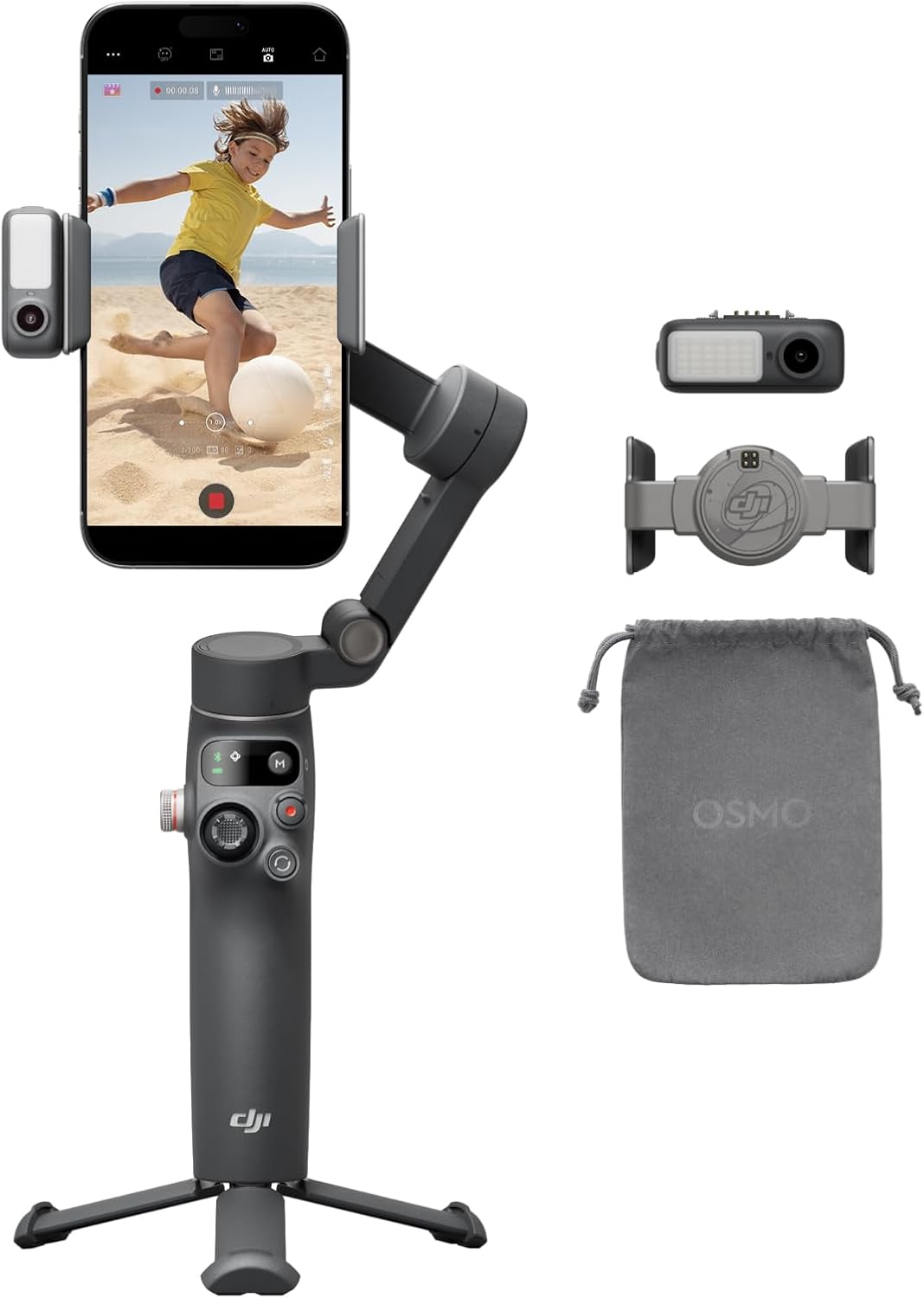
Smartphone gimbals help smooth walking shots, make self-recording easier and give creators repeatable framing tools. The DJI Osmo Mobile 7P offers several useful features in one portable device: a three-axis stabilizer, built-in tripod, extension rod and detachable Multifunctional Module. That module is the main reason to consider the 7P rather than the regular Osmo Mobile 7.
This guide separates manufacturer-stated capabilities from performance we have not independently tested. It focuses on practical purchase decisions: what the tracking features actually do, which phones fit, how battery life changes in real use cases, and which accessories may be needed.
DJI Osmo Mobile 7P specifications at a glance
| Feature | DJI specification |
|---|---|
| Stabilization | Three-axis motorized smartphone gimbal |
| Included module | Detachable Multifunctional Module with people-tracking, fill light and compatible wireless-mic reception |
| Supported phone weight | 170–300 g (6.0–10.6 oz) |
| Supported phone width / thickness | 67–84 mm wide; 6.9–10 mm thick |
| Extension rod | Built-in; up to 215 mm extension |
| Tripod | Built into handle; designed for stable, level, windless settings |
| Full kit weight | Approximately 368 g with clamp, tripod and module; excludes phone |
| Fill light | 2500–6000 K adjustable color temperature; up to 40 lux measured at 0.6 m |
| Charging | USB-C; approximately 2.5 hours with a 10 W charger |
These figures are from DJI's Osmo Mobile 7 Series specifications. Measurements do not establish how the product performs with every phone or under every shooting condition.
Two tracking systems, two different workflows
Multifunctional Module: tracking in a native camera app
The 7P package includes DJI's detachable Multifunctional Module. Attach it to the phone clamp and it can follow human subjects while you use the phone's native camera or supported third-party camera and livestreaming apps. DJI identifies examples including TikTok, Instagram, Blackmagic Camera and Protake; feature support can still vary by device, app version and recording mode.
DJI describes gesture controls, including showing your palm to begin or end tracking. This is potentially valuable for someone filming alone, but it is not a guarantee that the gimbal will keep a fast-moving person perfectly framed in crowded or obstructed scenes. DJI's official FAQ explains the difference between module tracking and ActiveTrack.
DJI Mimo: ActiveTrack in DJI's own app
ActiveTrack inside DJI Mimo is a separate software feature. DJI says Mimo's ActiveTrack can track people, animals and objects, whereas the Multifunctional Module's native-camera tracking is focused on people. Importantly, the Multifunctional Module's tracking function does not operate inside DJI Mimo. Choose the app workflow based on what you want to track, rather than assuming the two systems combine.
Before buying for a specific live-streaming or professional-camera app, check DJI's current smartphone list and whether that particular app and recording configuration support your intended functions.
Battery life: what “up to 10 hours” leaves out
The 10-hour figure is a best-case manufacturer rating, not a promise of ten hours of active subject tracking. DJI specifies three different operating scenarios:
| DJI test scenario | Approximate duration | Interpretation |
|---|---|---|
| Level, balanced, stationary, no additional accessories | 10 hours | Baseline manufacturer test |
| Module intelligent tracking on; fill light off | 5 hours | More relevant to unattended self-recording |
| Module intelligent tracking on; fill light at maximum brightness | 4 hours | More relevant to tracking with continuous light |
DJI also warns that charging your phone from the gimbal reduces gimbal operating time. Actual duration can differ with motion, settings and environment. If you need to film continuously for an event, plan around the shorter scenario and bring an external power solution rather than treating the 7P as an unlimited phone power bank. Source: DJI battery specifications.
Lighting, audio and extension rod: useful, with limits
Fill light comes from the module, not the clamp
The adjustable light is built into the Multifunctional Module, which attaches to the magnetic phone clamp. DJI lists an adjustable color temperature of 2500–6000 K and maximum illuminance of 40 lux at 0.6 meters. That makes it a potentially convenient close-range light for self-recording or quick interviews, but it is not a replacement for a larger dedicated light in difficult scenes. Turning it up also shortens battery life.
Wireless audio requires additional hardware
DJI says the module can receive audio from compatible DJI Mic 2 or DJI Mic Mini transmitters. Do not assume a wireless microphone is included in the 7P package. The correct phone-connection cable may also be needed for audio or phone charging. DJI's Multifunctional Module setup guide describes the connection requirements, including a separate USB-C-to-Lightning cable for applicable older iPhones.
Built-in tripod and extension rod
The 215 mm extension rod adds options for high and low angles and self-filming. The integrated tripod can help with desk-based talking-head videos. However, DJI explicitly limits its intended tripod use to stable, level surfaces without wind. Do not rely on it for unattended outdoor setups or precarious positions.
Will the Osmo Mobile 7P fit your phone?
The first compatibility test is physical fit: DJI specifies supported phones weighing 170–300 g, measuring 67–84 mm wide and 6.9–10 mm thick. Bulky cases, attached lenses, large external microphones or other accessories can change weight and balance. Dimensions alone do not guarantee every software feature will work.
- Measure the phone as used: include its case and any intended accessories, then compare with DJI's clamp and weight limits.
- Check device-specific software support: use DJI's official smartphone compatibility resources rather than assuming every iPhone or Android model is equivalent.
- Choose your tracking mode: native/third-party app with the module for people, or DJI Mimo's ActiveTrack for its supported subject types.
- Check ports and cables: plan for a compatible cable if you want phone charging or supported microphone audio.
- Check your intended filming environment: windy locations, long sessions and crowded tracking scenes may warrant other support gear or a simpler workflow.
Osmo Mobile 7P vs. Osmo Mobile 7
Both models provide three-axis stabilization and an integrated tripod. The primary reasons to choose the 7P are the included Multifunctional Module and built-in extension rod. The regular Osmo Mobile 7 can use the module, but DJI lists it as an optional purchase. The 7P is also heavier with its included accessories: approximately 368 g versus 300 g for the standard 7 configuration. If your only requirement is smoother handheld footage, the standard model may be the better-value starting point. Compare the total price of the regular 7 plus any needed tracking kit against a 7P bundle before deciding. Source: DJI model comparison FAQ.
Pros, limitations and our recommendation
Reasons to choose it
- Included tracking/lighting module for compatible apps and human-subject shooting
- Three-axis stabilization plus built-in tripod and extension rod
- Useful support for solo creators and short-form content workflows
- Multiple tracking options depending on software choice
Reasons to pause
- Four- to five-hour manufacturer estimates when module tracking is active
- Tracking modes have different app and subject restrictions
- Phone size, case and software compatibility need checking
- Microphones and some cables are separate purchases
Buy the 7P if you frequently film yourself or moving people, want the module included from day one, and value having a small light, tripod and extension rod in one kit. Consider the less expensive Osmo Mobile 7 if you mainly need stabilized handheld clips. Skip a gimbal altogether if your phone's existing stabilization already meets your needs, or if you require professional optics, sustained lighting or reliably unattended tracking in unpredictable conditions.
Frequently asked questions
Can DJI Osmo Mobile 7P track people in the iPhone or Android camera app?
DJI says yes, using the included Multifunctional Module, provided the phone/app setup is supported. The module's native-camera tracking is designed for people, not all objects or pets.
Does the Osmo Mobile 7P work without DJI Mimo?
The gimbal and module can support native and third-party camera workflows, but some DJI features, pairing and functions involve DJI Mimo. Check the official app instructions for your phone and intended mode.
How long does the battery last with tracking and the light on?
DJI publishes approximately four hours with intelligent tracking enabled and fill light at maximum brightness. The 10-hour headline figure comes from a different, more limited test condition.
Can the Osmo Mobile 7P charge my phone?
Yes, supported phone charging is available, but it reduces the gimbal's own operating time. For connections through the module, check DJI's required cable and setup instructions.
Research method and sources
Editorial method: We compared the published DJI specification sheet, product FAQ and module setup guide. This guide is an analysis of documented functionality and purchase tradeoffs; it is not based on a first-hand test, benchmark or independently verified battery run. Specifications, app support and bundle contents can change. Reviewed November 7, 2026.
- DJI — Osmo Mobile 7 Series technical specifications (dimensions, phone fit, light and operating-time conditions).
- DJI — Osmo Mobile 7 Series FAQ (model comparison, tracking workflows and compatibility).
- DJI Support — Multifunctional Module setup and cabling guide.
Final buying decision
The DJI Osmo Mobile 7P is worth considering when you specifically need its included tracking module, adjustable close-range light and extension rod. Verify that the seller includes the 7P module, confirm your phone fits and account for the shorter battery figures in tracking-heavy shoots. Prices, bundles and availability can change.
As an Amazon Associate I earn from qualifying purchases.
Check Current Price and Bundle on AmazonAmazon is the seller marketplace. Check the listing for the exact model and included accessories before ordering.