
Oura Ring 4 for PCOS & Cycle Tracking: Review
A practical look at how the Oura Ring 4 tracks overnight temperature trends, cycle-related signals, sleep and recovery — and what users with PCOS or irregular cycles should know before relying on wearable data.
Key Takeaways
- Temperature trends: Oura tracks overnight temperature trends that can provide useful information about changes across the menstrual cycle.
- PCOS is different: Oura can provide supporting wellness and cycle data, but it does not diagnose or treat PCOS.
- Natural Cycles integration: Compatible Oura Rings can sync overnight temperature trend data with Natural Cycles, whose algorithm calculates daily fertility status.
- Important limitation: Irregular or highly variable cycles can make fertility predictions more difficult, so wearable data should not be treated as a substitute for medical care.
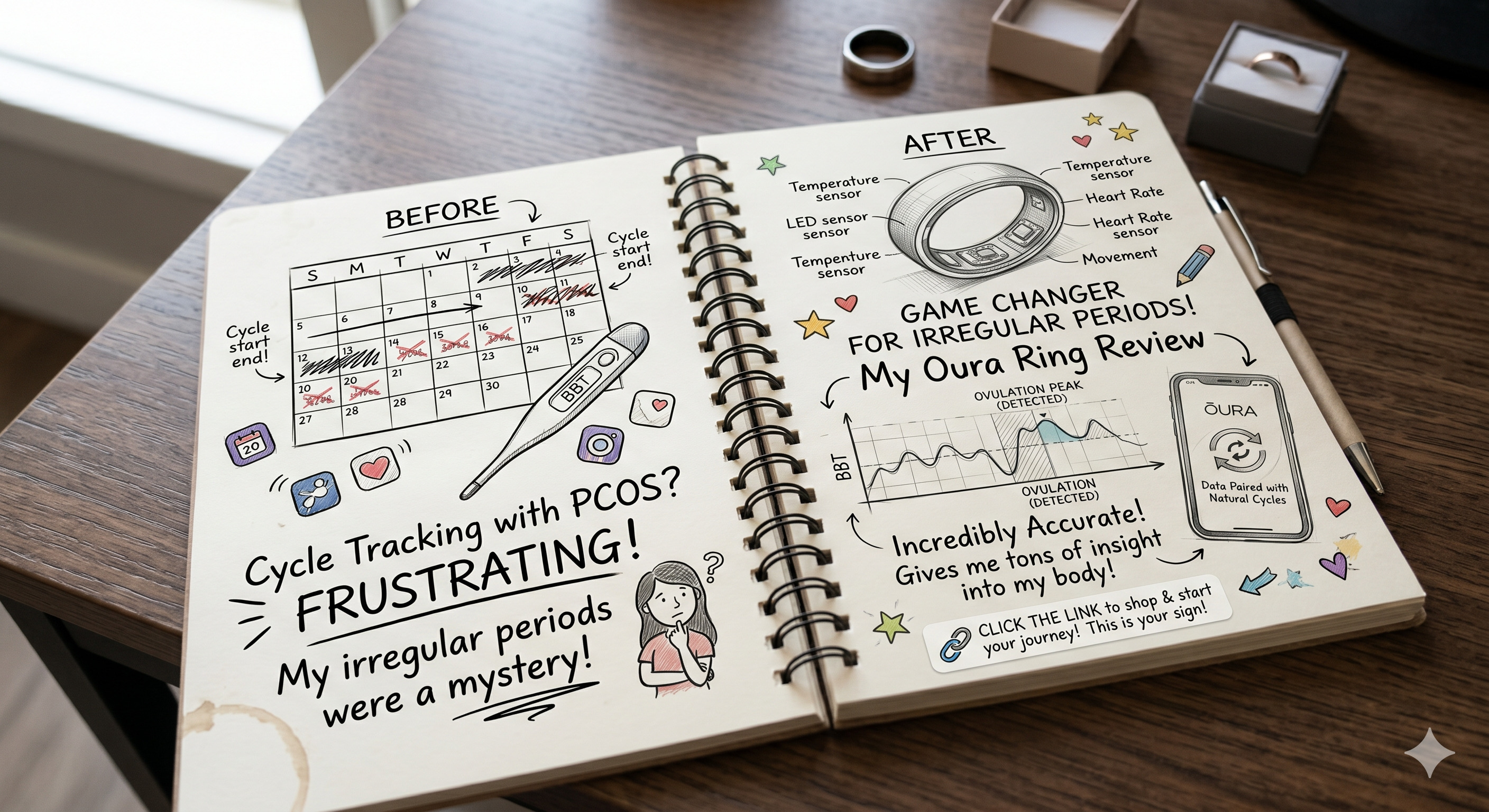
If you experience irregular periods or are managing PCOS, understanding your cycle can be more complicated than simply counting days on a calendar. Cycle length can vary, and physiological changes may not follow a predictable schedule.
The Oura Ring 4 approaches cycle tracking from a different direction. Rather than relying only on calendar dates, the ring collects overnight physiological signals, including temperature trends, that can be used to provide additional context about changes across the menstrual cycle.
Can the Oura Ring 4 Help With PCOS Tracking?
The important distinction is between tracking information and medical diagnosis.
Oura can collect data that may help users understand patterns in temperature, sleep, heart rate, HRV and menstrual-cycle-related changes. However, the ring does not diagnose PCOS, determine its severity, or replace clinical evaluation.
For someone already working with a healthcare professional, this type of longitudinal wearable data may provide additional context to discuss alongside other information. It should be viewed as a supporting wellness tool rather than a diagnostic system.
How Oura Tracks Temperature Trends
Oura measures temperature trends during sleep. These trends can change across different phases of the menstrual cycle and may therefore provide useful physiological context over time.
The important point is that Oura's temperature measurement is a trend signal, not a direct measurement of hormone levels or a standalone diagnosis of ovulation.
This distinction matters particularly for people with irregular cycles. A wearable can collect more data, but more data does not automatically mean that every prediction will be accurate.
Oura Ring 4 and Natural Cycles
One of the most significant integrations is with Natural Cycles.
Compatible Oura Rings can sync overnight temperature trend data with the Natural Cycles app. Natural Cycles then analyzes the data using its own algorithm to calculate a daily fertility status.
Natural Cycles is the FDA-cleared birth-control app. The FDA clearance applies to the Natural Cycles software, not to Oura Ring 4 as a standalone contraceptive device.
If contraception is the goal, users should follow the instructions and indications of Natural Cycles rather than treating Oura's own cycle or fertile-window features as contraception.
What Data Is Shared With Natural Cycles?
According to Oura's current integration documentation, temperature trend data collected overnight is synchronized with Natural Cycles. Oura states that other information, such as period data and other Oura metrics, is not transferred through this integration and must be handled separately.
A Natural Cycles subscription is also required to use the integration.
What About Ovulation Tracking?
Temperature patterns can provide useful information around the menstrual cycle, but it is important not to describe a wearable as determining ovulation with absolute certainty.
Oura's own documentation describes its Fertile Window feature as an aid for people trying to conceive and explicitly states that it should not be used as contraception.
For users who want contraception, Natural Cycles is the relevant FDA-cleared system that uses compatible Oura temperature data as part of its fertility-status calculation.
Important Considerations for PCOS and Irregular Cycles
This is where expectations need to remain realistic.
Irregular cycles can make fertility prediction more challenging. Oura's documentation notes that limited data are available for some shorter, longer or highly variable cycles and that irregular cycles can affect fertility-status predictions.
That does not make the ring useless for people with irregular cycles. It means that the data should be interpreted within the limitations of the specific tracking system and, where appropriate, discussed with a healthcare professional.
HRV, Sleep and Recovery Context
Cycle tracking is only one part of the Oura ecosystem. The ring also tracks metrics such as heart rate, HRV, sleep and activity-related signals.
These metrics can help users understand broader patterns in sleep and recovery. For example, someone may notice changes in sleep quality or HRV around different stages of their cycle.
However, HRV and sleep data should not be interpreted as direct measurements of hormonal status or PCOS severity.
For a broader look at the ring's sleep and recovery capabilities, see our Oura Ring 4 Executive Sleep & Recovery review .
Oura Ring 4 vs. a Traditional Smartwatch
The biggest practical difference is the form factor.
The Oura Ring 4 is screen-free and designed to be worn continuously, including overnight. That makes it attractive to users who want passive health and wellness tracking without adding another screen or notification source to their wrist.
If you are comparing the ring with an Apple Watch specifically for sleep and recovery tracking, our Oura Ring 4 vs. Apple Watch comparison provides a broader feature-by-feature analysis.
Who Is the Oura Ring 4 Best For?
- People who want passive overnight temperature and wellness tracking.
- Users interested in understanding menstrual-cycle patterns over time.
- People who want to integrate compatible Oura data with Natural Cycles.
- Users who prefer a screen-free wearable instead of a smartwatch.
- People who want sleep, HRV and recovery information alongside cycle-related data.
Who Should Be More Cautious?
- Anyone expecting the Oura Ring to diagnose PCOS.
- Anyone expecting the ring alone to provide guaranteed contraception.
- Users with highly irregular cycles who assume every fertility prediction will be precise.
- Anyone using wearable data instead of appropriate medical evaluation.
The Verdict
The Oura Ring 4 is a compelling wearable for people who want a continuous source of overnight temperature trends, sleep and recovery information in a screen-free form factor.
For people interested in menstrual-cycle tracking, its temperature data can provide useful additional context, and the Natural Cycles integration creates a more specialized fertility-tracking workflow.
But the strongest use case is data-informed tracking, not medical diagnosis. PCOS remains a medical condition that requires appropriate clinical evaluation, and irregular cycles can make fertility predictions more difficult.
In other words, the Oura Ring 4 can be a useful part of a broader health-tracking strategy — but it should not be treated as a replacement for professional medical advice or a standalone contraceptive device.
Related Hardware & Wearable Reviews
Frequently Asked Questions
Can the Oura Ring 4 help with cycle tracking if I have PCOS?
The Oura Ring 4 can provide overnight temperature trends and other wellness data that may help users understand cycle patterns. It does not diagnose or treat PCOS, and irregular or highly variable cycles can make fertility predictions less reliable.
Does the Oura Ring 4 work with Natural Cycles?
Yes. Compatible Oura Rings can sync overnight temperature trend data with Natural Cycles. Natural Cycles then analyzes that information to calculate daily fertility status. A Natural Cycles subscription is required.
Is the Oura Ring 4 FDA cleared for birth control?
No. The FDA-cleared birth-control product is Natural Cycles. Oura provides compatible temperature trend data that can be used by Natural Cycles. Oura's own Fertile Window feature should not be used as contraception.
Can Oura Ring 4 diagnose PCOS?
No. Oura Ring 4 is not a diagnostic tool for PCOS. It can provide wellness and cycle-related information, but diagnosis and treatment should be handled by an appropriately qualified healthcare professional.
Explore the Oura Ring 4
If you are considering Oura Ring 4 for sleep, recovery and cycle-related wellness tracking, check current availability and pricing before purchasing.
As an Amazon Associate I earn from qualifying purchases.
Check Availability & Pricing